Título en mano, visa en trámite: opciones migratorias para el sector salud
**From Professional Degree to a New Opportunity: A Guide for Health Professionals Seeking to Immigrate to the United States**
Immigrating to the United States to continue a career in the health sector is an achievable goal, but it requires planning, patience, and proper guidance. The process is not limited to obtaining a visa or completing a certification: it generally involves several independent steps that must be coordinated correctly.
This AHPSI guide aims to help you understand the differences between:
* Evaluation of your studies
* Professional certification or licensure
* Job search
* Authorization to work
* Visa or permanent residency process
Each of these steps has its own requirements. Completing a professional certification does not automatically guarantee a job offer, a visa, or permanent residency.
1. Before You Begin: Identify Your Professional Goal
The first step is to answer three fundamental questions:
1. What profession or role do you wish to practice in the United States?
2. Does that occupation require a state license?
3. Are you seeking a temporary opportunity or permanent settlement?
Professions such as medicine, nursing, physical therapy, and other regulated clinical occupations may require academic evaluation, English proficiency, national examinations, immigration certifications, and a license from the state where you intend to work.
A person may have immigration authorization and still not be authorized to practice a regulated profession. Likewise, someone may meet academic or professional requirements and still need a visa or work authorization.
2. Certification, License, Employment, and Visa: They Are Not the Same
It is important to clearly understand these differences:
**Professional Certification**
A certification attests to knowledge or competencies to perform certain functions. It can strengthen a résumé, facilitate preparation for exams, and improve employment prospects.
**Professional License**
This is the legal authorization granted by a state to practice a regulated profession. Requirements vary by profession and state.
**Job Offer**
This is a proposal made by an employer. Depending on the immigration category, that company or institution may need to file a petition or sponsor the worker.
**Visa or Immigration Status**
This is the legal mechanism that allows entry, stay, or work in the United States under specific conditions.
Therefore:
**Certification ≠ state license ≠ job offer ≠ visa.**
These are related processes, but they are different.
3. Main Temporary Visas for Health Professionals
**H-1B: Specialty Occupations**
The H-1B classification may be used for positions that normally require at least a specific bachelor’s degree related to the job. The U.S. employer must file the corresponding petition.
It may apply to certain physicians, researchers, specialists, and other health professionals when the position meets the requirements of a specialty occupation. However, not all health care positions or nursing roles automatically qualify.
In addition to immigration approval, the professional must meet the licensing requirements applicable to their occupation. Consult the official USCIS information on the H-1B classification.
**J-1: Exchange, Training, and Medical Education**
The J-1 visa is used to participate in authorized exchange programs. In the health sector, it is particularly known for its use in graduate medical education programs, such as residencies and training for foreign physicians.
Some participants—including those receiving graduate medical education or training—are subject to the requirement to return physically to their country of origin for two years, unless they obtain a valid waiver. Consult the U.S. Department of State information on the J-1 visa and the two-year residence requirement.
**O-1: Extraordinary Ability**
The O-1 classification may benefit individuals with extraordinary ability and sustained recognition in areas such as science, education, or business.
A health professional with research, publications, awards, leadership, original contributions, or other notable achievements may explore this option. Experience or an advanced degree alone is not sufficient; solid evidence of professional recognition is required. Consult the official USCIS explanation of the O-1 visa.
**TN: Professionals from Mexico and Canada**
The TN classification is available only to citizens of Mexico and Canada who will practice a profession included in the United States-Mexico-Canada Agreement.
The list includes certain health occupations, but each has specific academic and professional requirements. It should not be assumed that any physician, nurse, dentist, or technician can use it. In particular, the physician category has limitations related to teaching and research, and direct patient care may only be incidental to those activities.
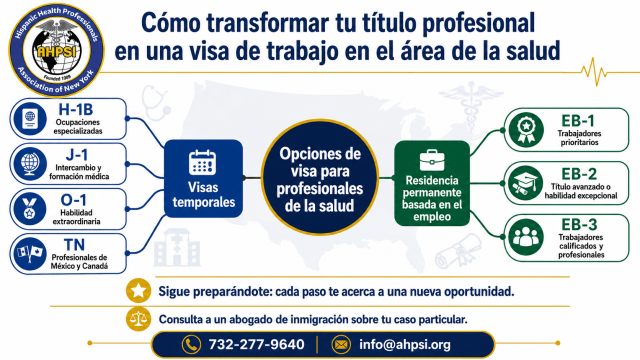
4. Employment-Based Permanent Residency
**EB-1: Priority Workers**
The EB-1 category includes, among other groups, individuals with extraordinary ability, outstanding professors or researchers, and certain multinational executives or managers.
In some cases of extraordinary ability, a job offer is not required, but the applicant must demonstrate sustained national or international recognition and that they will continue working in their area of expertise. Consult the official information on EB-1.
**EB-2: Advanced Degrees or Exceptional Ability**
The EB-2 category may apply to professionals whose position requires an advanced degree or to individuals who demonstrate exceptional ability.
Some applicants may request a National Interest Waiver (NIW) if they demonstrate that their work has substantial merit and national importance and that it would benefit the United States to waive certain usual requirements. Holding a master’s or doctoral degree alone does not guarantee approval. Consult the official EB-2 requirements.
**EB-3: Skilled Workers, Professionals, and Other Workers**
The EB-3 category may be used for skilled workers, professionals, and other workers. It generally requires a permanent job offer and the employer’s participation in the immigration process.
Registered professional nurses and physical therapists are included in Schedule A, Group I. This allows a particular labor certification process, but it does not eliminate professional, immigration, or licensing requirements. Consult the official USCIS information on EB-3.
5. Additional Requirements for Health Care Workers
Certain foreign professionals need a health care worker certification for immigration purposes. This evaluation may include:
* Education and professional training
* License obtained in the country of origin
* English proficiency
* Passage of the corresponding examinations
* Comparison of the training received with U.S. requirements
This requirement may apply to registered nurses, practical or vocational nurses, physical therapists, occupational therapists, speech-language pathologists, audiologists, medical technologists, laboratory technicians, and physician assistants, among other officially defined occupations. Consult the USCIS page on health care worker certification.
This specialized immigration certification should also not be confused with an educational or vocational certification offered by a training institution.
6. How Do AHPSI Certifications Relate to This Process?
AHPSI offers preparation and certification programs in areas such as:
* Medical Assistant
* Phlebotomy Technician
* EKG Technician
* Patient Care Technician
* Nursing Assistant
* Mental Health Technician
* Surgical Assistant
* Physical Therapy Assistant
* Registered Diagnostic Medical Sonographer
These certifications can help the participant to:
* Update knowledge
* Understand the U.S. health care system
* Prepare for certain examinations
* Strengthen their résumé
* Develop competencies related to entry-level positions in the health sector
* Present themselves better prepared to potential employers
However, an AHPSI certification:
* Does not constitute a visa
* Does not grant work authorization
* Does not guarantee a job offer
* Does not replace a state license
* Does not equal employer immigration sponsorship
* Does not guarantee approval of an immigration petition
Its function is educational and professional. It can be a valuable piece within a broader strategy, but the immigration process must be evaluated by an authorized immigration attorney.
7. Recommended Practical Path
**Step 1: Organize Your Documents**
Gather diplomas, certifications, course transcripts, grades, clinical hour records, licenses, employment letters, publications, recognitions, and identity documents.
**Step 2: Evaluate Your Studies**
Request an academic evaluation through an organization accepted by the relevant professional board, educational institution, immigration agency, or employer. Not all evaluations serve all purposes.
**Step 3: Research the License for Your Profession**
Consult directly with the regulatory board of the state where you wish to work. Requirements can vary considerably from one state to another.
**Step 4: Strengthen Your Profile**
Improve your English, prepare a U.S.-style résumé, complete relevant courses, obtain certifications related to your goal, and keep all professional credentials current.
**Step 5: Research Legitimate Employers**
Confirm that the institution exists, that the vacancy is real, and that the person offering the job is authorized to do so. Be wary of promises of a “guaranteed visa,” informal payments, or contracts you cannot review before signing.
**Step 6: Consult an Immigration Attorney**
Before paying for alleged sponsorship, signing a contract, or making important decisions, consult an authorized immigration attorney. The correct category depends on your nationality, profession, experience, education, immigration history, employer, and personal goal.
**Step 7: Keep the Processes Separate and Coordinated**
Advance simultaneously in your professional preparation and immigration guidance, but remember that each process must be completed before the corresponding authority.
8. Practical Tips to Protect Your Future
* Do not buy tickets or resign from your job based solely on a verbal promise.
* Do not hand over original documents to intermediaries without receiving receipts.
* Request in writing the costs, services, and conditions of any program.
* Directly verify the credentials of the attorney, employer, and agency.
* Keep digital copies of all your documents.
* Do not provide false information or submit altered documents.
* Do not assume that a visitor visa authorizes you to work.
* Prepare a realistic budget for evaluations, translations, exams, licenses, and legal advice.
* Keep your résumé updated and continue studying English.
* Work with an individual plan; another person’s immigration experience may not apply to your case.
A Message of Hope
Starting over in another country can create uncertainty. Many health professionals arrive in the United States with years of study, experience, and a vocation for service, only to discover that they must validate documents, complete new requirements, or begin from a different position.
That does not mean their preparation has lost value.
Every evaluation passed, every course completed, every exam taken, and every professional contact represents a step toward your goal. The path may be longer than expected, but with reliable information, legal guidance, consistent preparation, and prudent decisions, it is possible to keep moving forward.
Do not let haste expose you to false promises. Turn your hope into a plan, your experience into a strength, and each requirement into an achievable goal.
**AHPSI: Education, Guidance, and Hope for Health Professionals.**
For information about our preparation and certification programs:
Phone: 732-277-9640
Email: info@ahpsi.org
Website: http://www.ahpsi.org
**Important Notice:** This document is for educational and informational purposes only. AHPSI does not provide legal advice and does not guarantee employment, sponsorship, visa, professional license, or permanent residency. Laws, policies, and requirements may change. Every individual must consult their particular situation with an authorized immigration attorney and with the regulatory board of their profession.
.

